10/10
5/10
10/10
10/10
10/10
10/10
A Symphony of Flesh and Chrome: The Erotics of Twisted Metal
There is a deeply buried, practically universal psychological fascination with destruction—an unexplained, childish kink of smashing toy cars together on the living room floor just to witness the violent kinetic energy of the impact. With his 1996 masterpiece Crash, the master of visceral cinema, David Cronenberg, isolates that buried impulse, excavates it from our collective subconscious, and mutates it into its ultimate adult manifestation. Adapting J.G. Ballard’s profoundly transgressive novel, Cronenberg delivers a film that is so primal, so instinctually captivating, that it entirely bypasses the logical centers of the brain. It scales our darkest, most inexplicable fixations into an unexplainable, satisfactory, simulating experience that seamlessly fuses sex, violence, and crashing cars into a singular, intoxicating religion. It is a 10/10 in all senses—a film that is entirely, completely unlike anything else ever committed to celluloid.
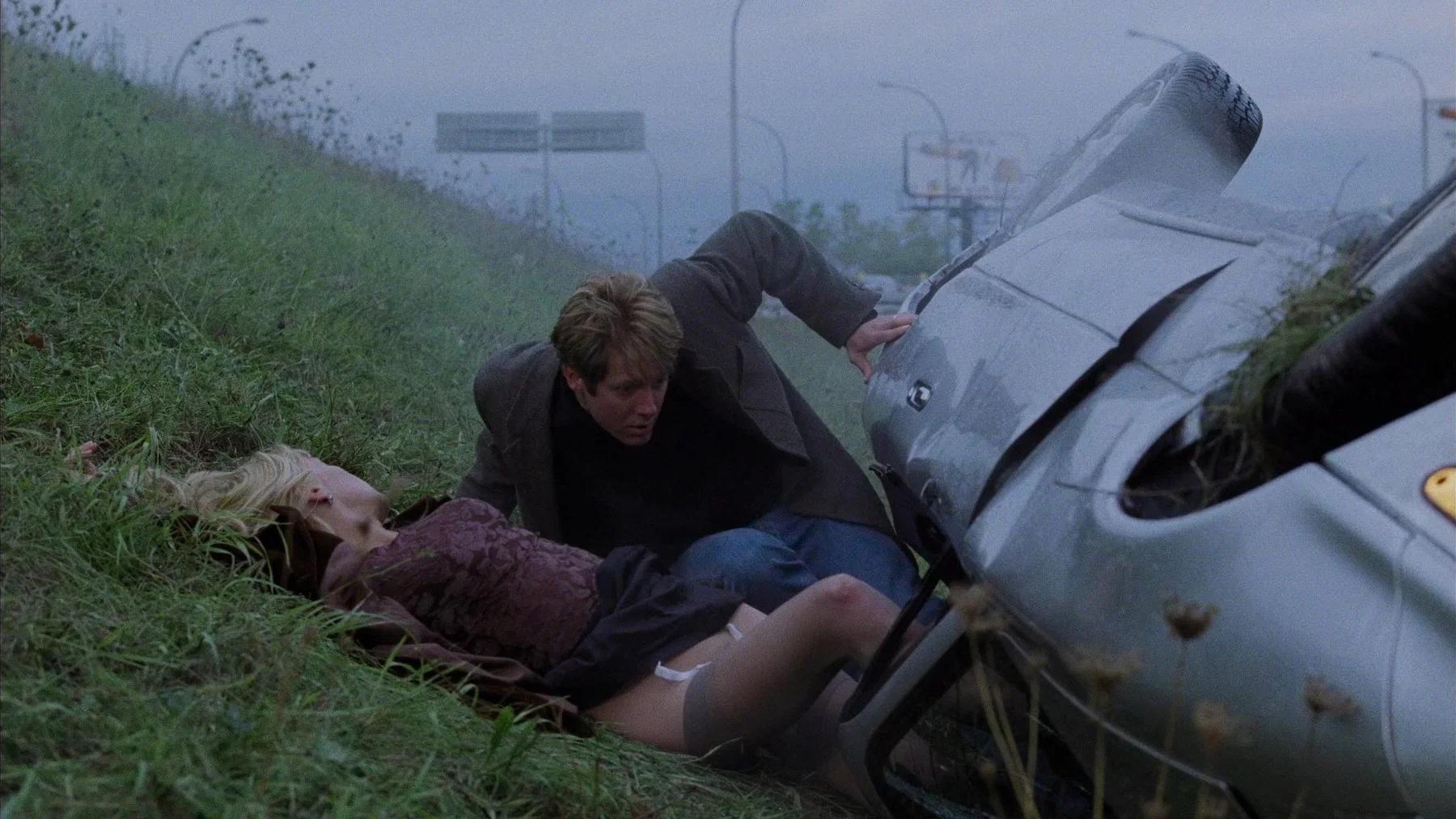
To enter the world of Crash is to step into a reality that operates on a completely different set of moral and biological frequencies. The film follows James Ballard (James Spader) and his wife Catherine (Deborah Kara Unger), an affluent, emotionally hollowed-out couple whose marriage is sustained entirely by the detached recounting of their respective extramarital affairs. They are sleepwalking through a sterilized modern existence until James is involved in a catastrophic, near-fatal head-on collision. The violent tearing of metal and the shattering of windshield glass acts as a spiritual defibrillator. Through the trauma of the crash, James is introduced to an underground subculture of symphorophiliacs led by Vaughan (Elias Koteas), a former scientist who has discovered a new, terrifying frontier of human connection: the eroticization of traffic accidents.
What makes Crash so deeply strange, disturbing, and yet undeniably satisfying is how Cronenberg refuses to judge or moralize his subjects. He treats their vehicular fetishism with the deadpan earnestness of a religious awakening. The characters are not portrayed as raving lunatics; they are explorers charting the uncharted territory where the human body intersects with industrial technology. Every sexual encounter in the film is mechanically entangled with the architecture of the automobile—leather interiors, steering wheels, gear shifts, and the jagged edges of mangled steel become extensions of human genitalia. It is an instinctual descent into a brave new world where the scars of a car crash are revered as the ultimate physical manifestation of intimacy.
The performances are universally mesmerizing in their alien detachment. James Spader utilizes his signature brand of soft-spoken, almost reptilian curiosity perfectly, playing James as a man slowly awakening to a terrifyingly specific new hunger. Deborah Kara Unger is a revelation, projecting a haunting, heavy-lidded exhaustion that suddenly flares into electric, desperate desire when surrounded by the wreckage of the highway. Holly Hunter, playing Dr. Helen Remington—the widow of the man James killed in the inciting crash—brings an aching, broken vulnerability to the screen, finding a twisted solace in the man responsible for her tragedy. But it is Elias Koteas as Vaughan who acts as the film's dark, magnetic prophet. Koteas infuses Vaughan with the unhinged charisma of a cult leader, a man who views the mangling of flesh and steel not as a tragedy, but as the next necessary step in human evolution.
Cronenberg’s visual language is a masterclass in clinical voyeurism. Working with his longtime cinematographer Peter Suschitzky, he shoots the highways, parking garages, and hospital wards of Toronto with a cold, metallic sheen. The lighting is harsh, reflecting off the chrome of the vehicles and the sweat on the actors' skin, creating an atmosphere that is simultaneously sterile and deeply, undeniably erotic. There is a deliberate, hypnotic rhythm to the way the camera lingers on the orthopedic braces, the deep scar tissue, and the crushed chassis of the automobiles. It dares you to look away, but the composition is so flawless that it holds your gaze in a vise grip.
The atmosphere is further elevated into the realm of the transcendent by Howard Shore’s brilliant, unorthodox score. Shore abandons traditional melodies in favor of an ensemble of electric guitars, harps, and woodwinds, creating a metallic, droning soundscape that sounds like the slow-motion bending of steel. The music hums with a dangerous, electric tension, perfectly mirroring the internal frequencies of characters who only feel alive when they are accelerating toward the concrete median.
Crash is a towering achievement of transgressive cinema, an exhaustive exploration of how modern humanity attempts to feel something—anything—in a world numbed by technology and oversaturation. It is a film that dares to suggest that within the horrific violence of a car crash lies a bizarre, primal beauty, an instinctual release of energy that mirrors the climax of the sexual act. It is strange. It is disturbing. But above all, it is profoundly, unexplainably satisfying. Cronenberg does not just push boundaries here; he accelerates right through the windshield of conventional cinema, leaving us bleeding, breathless, and completely captivated in the passenger seat.