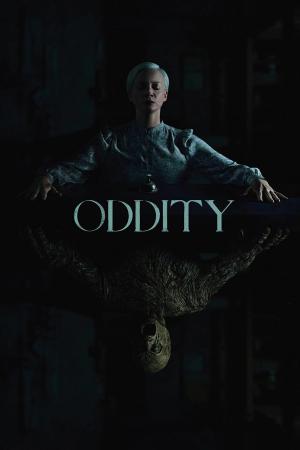
9.5/10
8/10
7/10
9/10
9/10
8.5/10
Checking In, Never Checking Out: McCarthy's Masterclass in Spatial Dread
With Hokum, Irish filmmaker Damian McCarthy proves that his breakout successes with Caveat and Oddity were no mere genre flukes—they were the foundational blueprints of a modern horror master finding his voice. In an era where independent horror often mistakes bloated, exposition-heavy mythology for genuine depth, McCarthy delivers a nasty, nerve-shredding ghost story that knows exactly what it is and precisely how big it needs to be. Hokum doesn’t chew more than it can handle; instead, it weaponizes its modesty, trapping the viewer in a state of chest-crushing tension that refuses to dissipate until long after the final frame.
At its core, Hokum is a localized haunting wrapped in the gritty, grounded textures of a crime thriller, but McCarthy's true achievement lies in his ability to weaponize isolation. The film follows Ohm Bauman (Adam Scott), an embittered American novelist who travels to the remote, winter-locked Bilberry Woods Hotel in rural Ireland. His stated purpose is to scatter his recently deceased parents' ashes, arriving just as the fading, cavernous property is shutting down for the off-season. It is a setup that naturally invites comparisons to the cinematic isolation of The Shining or the contained madness of 1408, yet McCarthy’s haunting is decidedly more eccentric, steeped in local folklore and deeply tethered to his protagonist's rotting psyche.
Adam Scott delivers what might be the most fascinatingly unlikable protagonist in recent horror memory, a bold subversion of the typical "sympathetic victim" trope. Ohm is a deeply abrasive cynic carrying massive, unresolved trauma, and Scott plays him with a brilliant, bitter conviction. This is a man so profoundly unpleasant, so entirely consumed by his own grief and hostility, that he casually burns an overly talkative staff member's hand with a hot teaspoon rather than engage in polite conversation. It is a remarkably risky characterization that works wonders because it grounds the escalating supernatural elements in a harsh, ugly reality. We aren't just watching a man being haunted by a hotel; we are watching a man who is already haunting himself.
The visual design of Hokum deserves recognition as one of the most effectively realized architectural nightmares of the decade. Working alongside cinematographer Cole Hogan, McCarthy shoots the Bilberry Woods Hotel not as a building, but as a predatory organism. He understands that true horror often resides in the negative space—the oppressive shadows lurking in the corners of the honeymoon suite, the terrifying implication of a door left ajar, the impossible geometry of the hotel's lower levels. The camera moves with a deliberate, voyeuristic patience, making the rural Irish countryside outside feel entirely cut off from the rest of humanity, while the interior spaces feel simultaneously too vast to conquer and too claustrophobic to endure.
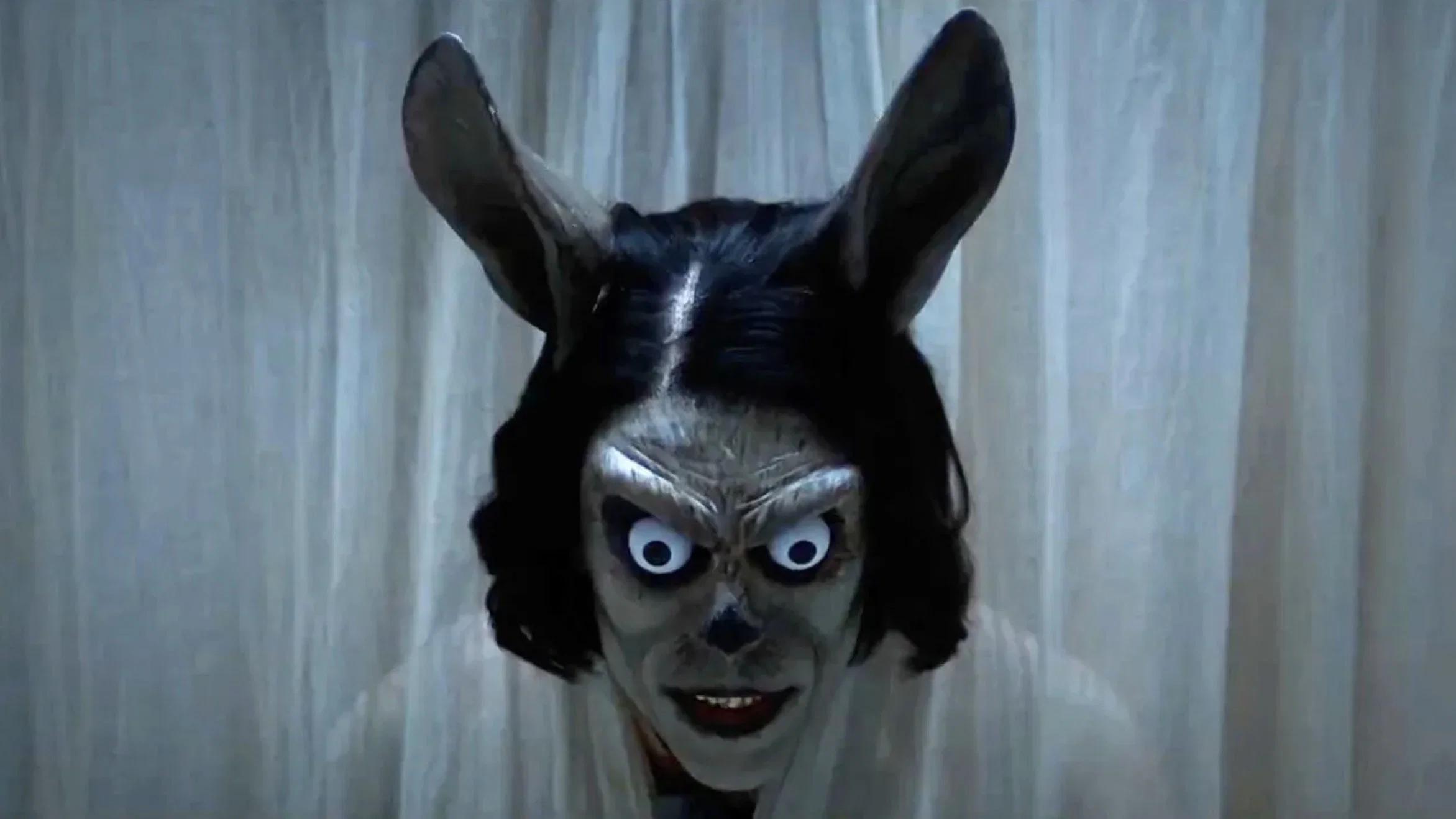
But it is the film’s masterful integration of Irish folklore and McCarthy's signature use of tactile, cursed objects that truly sets it apart. Ohm is warned of a local legend—a witch tied to the land who allegedly claims the honeymoon suite as her own—but the folklore is never spoon-fed. Instead, it manifests through deeply unsettling, physical intrusions. Much like the wooden mannequin in Oddity, McCarthy introduces bizarre, folk-art artifacts into Ohm's space: strange woven effigies and antiquated hotel machinery that seem to possess a malevolent agency. McCarthy understands that the best horror often comes from the familiar made strange, and his camera lingers on these objects until they become sources of mounting, agonizing unease.
The sound design operates as a standalone tool of terror, working in perfect, dreadful harmony with the film's oppressive visual palette. McCarthy employs distinct auditory motifs—the crackle of a defunct internal comms system, the relentless, rhythmic knocking from empty adjacent rooms, the sudden, violent ring of an antique desk bell—to keep the audience perpetually off-balance. He uses silence just as effectively, allowing the natural sounds of the settling hotel and the howling winter wind to become instruments of dread. When the supernatural elements do manifest, the audio design never oversells them; instead, it creates the terrifying sensation that the hotel itself is holding its breath.
Hokum’s approach to its supernatural elements demonstrates a sophisticated understanding of horror's power to literalize emotional decay. Ohm’s traumatic past, specifically the murky, potentially criminal circumstances surrounding his parents' death, bleeds seamlessly into the hotel's paranormal activity. The witch of Bilberry Woods isn't just a monster waiting in the dark; she acts as a catalyst, a supernatural mirror reflecting Ohm's profound guilt and anger back at him. The thriller elements of the film—the slow unravelling of what actually happened to his parents—are perfectly paced alongside the ghostly manifestations, making the narrative feel both intellectually satisfying and viscerally terrifying.
McCarthy’s direction shows remarkable restraint throughout the film's runtime. He never rushes toward easy jump scares or telegraphs his intentions with booming musical cues. He builds tension through accumulation rather than sheer escalation, trusting his audience to sit in the discomfort. The pacing reflects the agonizingly slow dread of a waking nightmare. This approach requires tremendous confidence, relying on the heavy, chest-tightening atmosphere to do the heavy lifting that lesser directors would assign to CGI or gore.
The supporting cast, though sparse due to the film's isolated nature, perfectly grounds the narrative. The hotel's skeleton crew and the locals Ohm encounters are presented as authentic, weary individuals rather than broad horror archetypes. Their grounded, distinctly Irish pragmatism serves as a sharp, necessary contrast to Ohm's distinctly American entitlement and eventual descent into supernatural madness.
What Hokum ultimately achieves is a sublime exercise in "hospitality horror"—the violation of a space meant for rest and sanctuary. It proves that independent horror can compete with any studio blockbuster when craft, vision, and a genuine understanding of fear align. The production design, editing, and cinematography all serve the story's grim needs without drawing unnecessary attention to themselves, creating a seamless experience of dread.
Hokum represents everything that makes indie horror the genre's beating heart. It is a film that honors the patient build-up of classical ghost stories while incorporating contemporary sensibilities about trauma, guilt, and crime. Damian McCarthy has crafted something genuinely unnerving and emotionally jagged. In a cinematic landscape constantly trying to go bigger, Hokum proves that sometimes the most terrifying thing you can do is lock the door, turn out the lights, and force us to sit in the dark with our own demons.