9.5/10
0/10
8/10
10/10
9.5/10
10/10
The Architecture of Cruelty: Invisible Walls and Infinite Sins
While a sprawling, three-hour avant-garde psychological drama might initially seem like a slight detour for a site dedicated to horror, Lars von Trier’s Dogville earns its place here through sheer, unadulterated spiritual brutality. It does not deal in ghosts, masked killers, or the supernatural, but it orchestrates a descent into human depravity so profound and unsettling that it easily eclipses the terror of conventional genre fare. From the bizarre, disorienting first moment it opens, Dogville announces itself as a cinematic litmus test. Depending on who you ask, it is either a grueling endurance run that has viewers constantly checking the clock, or it is a hypnotic, transcendent masterpiece that swallows you whole. For those who surrender to its strange wavelength, you cease to be a passive viewer; you are pulled entirely into the void, standing on that vast, blackened soundstage, watching the disintegration of human decency in horrifying proximity.
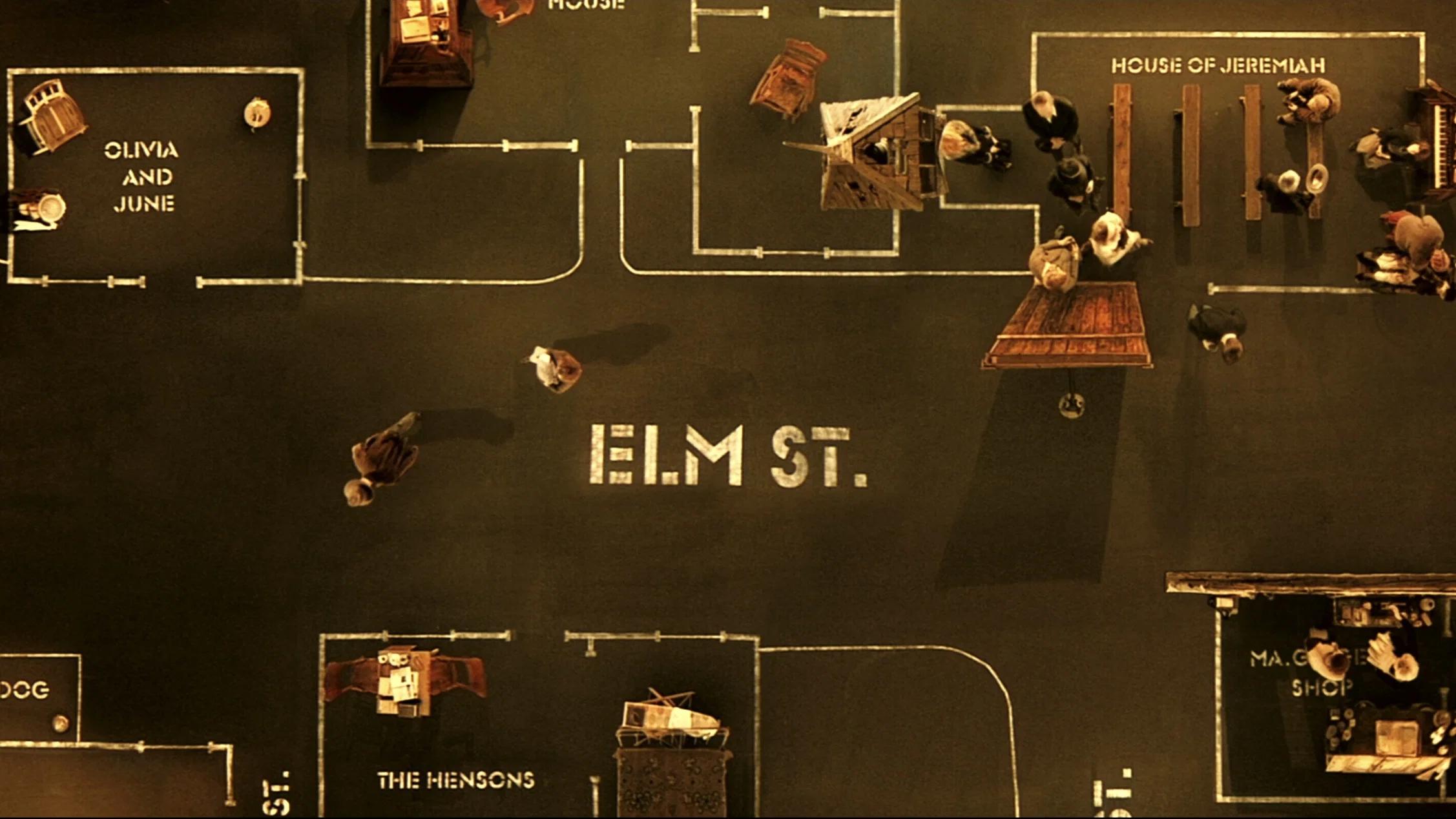
The film's most famous and audacious choice is its setting. There is no actual town of Dogville. The entire film is shot on a bare, cavernous soundstage in Sweden. The houses, the streets, the dog, and the gooseberry bushes are merely chalk outlines drawn on a black floor. There are a few sparse props—a desk, a bed, an apple orchard represented by a few barren branches—but crucially, there are no walls. This heavy, inescapable symbolism is the foundation of the film's psychological horror. Because there are no walls, the audience is forced to adopt an omniscient, god-like perspective. We can see every resident of the town simultaneously. When the horrific abuses of the second and third acts begin to unfold behind "closed doors," they are happening in plain sight. The townsfolk go about their daily routines, sweeping invisible porches and chatting in the street, while unspeakable violations occur just feet away. The lack of walls exposes the ultimate horror: it is not that the town doesn't know what is happening; it is that they do not care.
The narrative follows Grace (Nicole Kidman), a beautiful, mysterious fugitive fleeing a cartel of gangsters. She arrives in the isolated Rocky Mountain town of Dogville, where the self-appointed moral philosopher of the community, Tom Edison (Paul Bettany), convinces the skeptical locals to hide her. In exchange, Grace offers to help the townsfolk with small, unnecessary chores. At first, it is an idyllic, Capra-esque arrangement. But von Trier masterfully, agonizingly charts the insidious corruption of absolute power. As the risk of harboring Grace increases with the arrival of the police, the town's demands metastasize. What begins as a few extra hours of weeding turns into indentured servitude, which curdles into relentless psychological exploitation, and ultimately, systematic sexual violence.
If there is a singular, structural pivot in Dogville—a moment where the simmering unease permanently tips into a freefall of waking nightmare—it is Grace’s failed escape attempt hidden in the bed of an apple truck. Much like the infamous, torrential doorbell ring in Bong Joon-ho’s Parasite, this sequence violently cleaves the film in two. The atmosphere irreversibly curdles. What was previously a slow, insidious creep of exploitation drops its remaining pretense of civility. The betrayal she suffers during this desperate flight in the dark is so profound, so casually cruel and humiliating, that it plunges the narrative into a whole other realm of disturbing. From that moment on, the chalk outlines of Dogville cease to represent a quaint, quirky community and fully solidify into the impenetrable, inescapable walls of a maximum-security gulag.
Nicole Kidman delivers a career-defining performance as Grace in the wake of this shift. She is tasked with embodying a nearly messianic level of forgiveness, absorbing the town's escalating cruelties with a fragile, heartbreaking empathy. We watch her physical and spiritual posture completely collapse under the weight of the town’s hypocrisy. Her ultimate degradation—being literally fitted with a heavy, spiked iron collar and chained to a massive iron wheel to prevent another escape—is a piece of imagery so brutally medieval and jarring that it permanently sears itself into the viewer's subconscious.
Opposite her, Paul Bettany’s Tom represents perhaps the most insidious monster in the film. He views himself as Grace’s savior and the town’s intellectual superior, yet he is a creature of profound, spineless cowardice. He constantly rationalizes the town's abuse, framing it as a fascinating sociological experiment rather than a sequence of atrocities. He is the bystander who does nothing, weaponizing his own intellectual detachment to avoid taking a moral stand. The supporting cast—featuring heavyweights like Lauren Bacall, Stellan Skarsgård, and Chloë Sevigny—brings the hypocritical, small-town archetypes to vivid, terrifying life. They are frightening precisely because they are not mustache-twirling villains; they are ordinary, mundane people who, when handed absolute power over a vulnerable human being, instinctively choose tyranny.
Dogville is an exhaustive, heavily symbolic exploration of the human condition, American capitalism, and the fatal flaw of unconditional forgiveness. Von Trier strips away the aesthetic comforts of cinema—the lush landscapes, the dynamic lighting, the immersive sets—forcing the audience to focus entirely on the ugly, naked truth of the characters' actions. It is a suffocating environment, an experimental arthouse nightmare that refuses to grant the viewer a moment of visual or emotional respite.
When the film finally reaches its agonizing, fiery climax, the emotional whiplash is devastating. After nearly three hours of grueling, passive suffering, the arrival of Old Testament vengeance is both deeply cathartic and fundamentally sickening. The brutal retribution inflicted upon the town of Dogville leaves the viewer wrestling with their own moral compass, questioning the terrifying satisfaction of absolute, unmerciful violence.
Dogville is not a film for everyone. It is a demanding, abrasive, and entirely bizarre ride. But for those willing to endure its stark, theatrical cruelty, it stands as a towering, unsettling masterpiece. It proves that the most harrowing horrors do not require shadows to hide in—they require only ordinary people, a chalk outline, and the terrifying realization that humanity's capacity for evil is bound only by its opportunity.